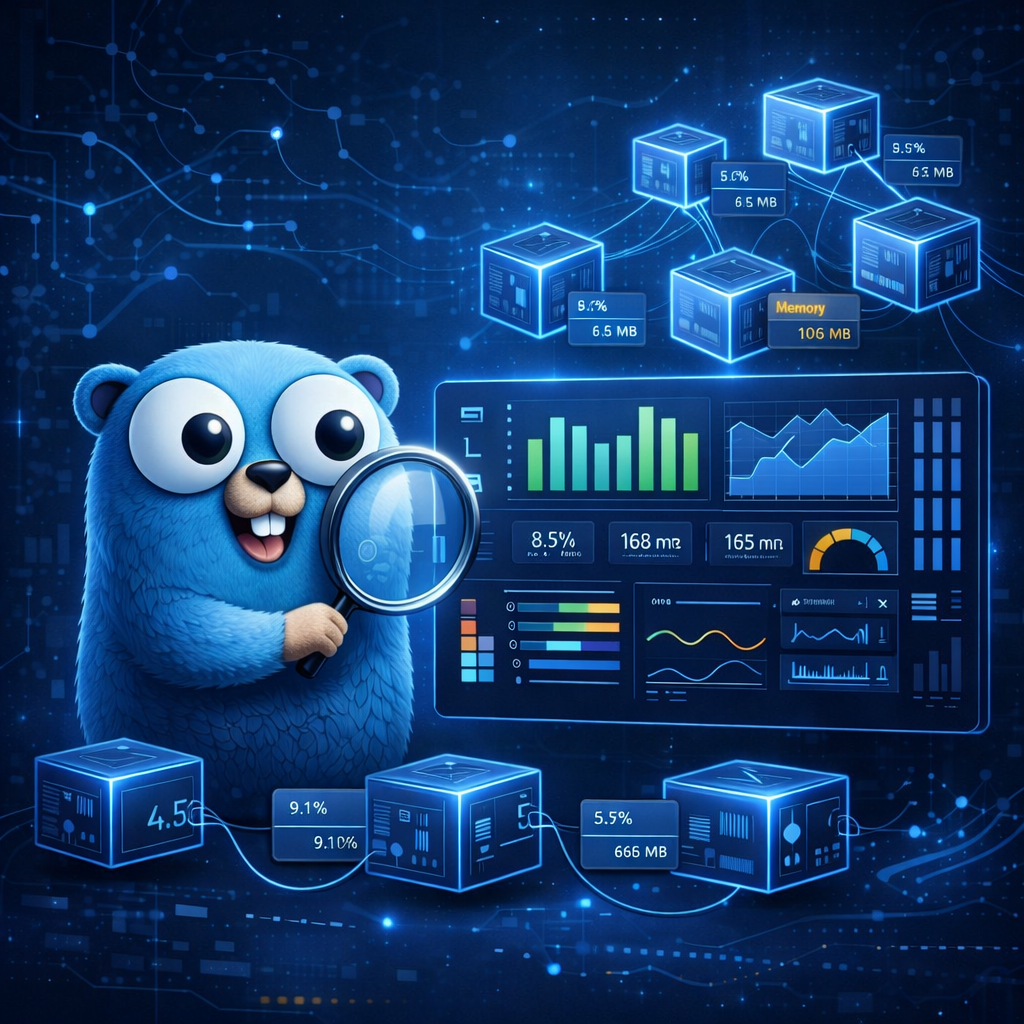
Go Channels and Ownership
Continuing my Go back-to-basics series, this time I'm covering channels, who owns close, and what a buffer actually changes. I went back through the topic with a small example and a few notes along the way.
15+ years in software engineering. Since 2022 building high-throughput distributed systems in Go, in environments where correctness and uptime matter.

Started with Dataflex, building ERP and logistics software for freight companies. A decade in Java, mostly in public accounting: municipal tax systems, fiscal documents, the kind of software that has to be right. Then logistics at Ambev, and high-volume shipment systems at Mercado Livre, building Go microservices for the delivery pipeline under tight latency. Now at McGraw Hill, building an offer pricing orchestrator that ties together the full pricing chain for products and services across one of the largest edtech e-commerce platforms in the US. 15+ years in, still finding new things to break and fix.































Consolidated pricing rules from multiple internal sources into a single Go API, giving the commercial team one place to manage offer logic. Built with DDD and Clean Architecture. Designed serverless workflows on AWS (Lambda, Step Functions, SQS, SNS) to replace manual financial processes. Service runs at Apdex 0.99 with error rate under 0.5%. Also contributed to the Angular admin UI.
Part-time contract via micro1. Evaluated Go repositories and ranked model outputs from Grok and Claude Opus. Submitted original Go projects as evaluation benchmarks for model training data.
Built event-driven Go microservices for the logistics pipeline, operating under the squad's p99 budget of 100-200ms. Owned the package-vs-vehicle cost calculation for the daily delivery plan, optimizing carrier contract matching. Wrote a TypeScript BFF unifying multiple backend calls into a single mobile contract. Also worked on Mercado Pago's Meli Dolar (MUSD) and Mercado Coin stablecoin flows.
Operated fiscal document issuance (CT-e, MDFe) for thousands of daily transportation events across AB InBev's nationwide distribution. A single outage once blocked an entire distribution center, queuing trucks until throughput recovered. Led migration from on-premises to Microsoft Azure. On-call for the issuance pipeline.
Migrated fiscal and tax systems serving 850+ municipalities and 3,000+ public agencies from J2EE monoliths on Oracle and Sybase to Spring Boot microservices on PostgreSQL, moving millions of records to a multi-tenant cloud architecture. Used Kafka for high-volume data migration. Built AngularJS and JavaScript frontends that replaced rigid legacy interfaces for public servants. Operated Kubernetes and AWS workloads for the platform.
Shared AI coding rules, workflow skills, and provider configs behind every agentic workflow I run, portable across Copilot, Claude Code, Codex, and opencode.
Stateless HTTP service that calculates a vehicle loan annual percentage rate (APR) from loan terms, credit profile, and vehicle attributes.
Go concurrency primitives explored through minimal, race-tested examples, benchmarks, and canonical literature references, from goroutines to atomics.
Go monorepo issuing cashback as ERC-20 tokens on Ethereum. Uses go-ethereum, Solidity, NATS JetStream for idempotent minting, and gRPC for wallet operations.
Stateful TCP-based message processing system with job distribution, cryptographic validation, and async statistics processing.
Service API for crypto exchange operations and integrations.
Educational project focused on runtime and blockchain concepts, keeping the implementation intentionally simple.
Service responsible for evaluating offer eligibility based on business rules and constraints.
Go + React workbench for quoting, submitting, and orchestrating bot transactions against a simulated Rust chain service.